
The Version Conflict Tax: What Duplicate Comp Files Cost Your Brokerage


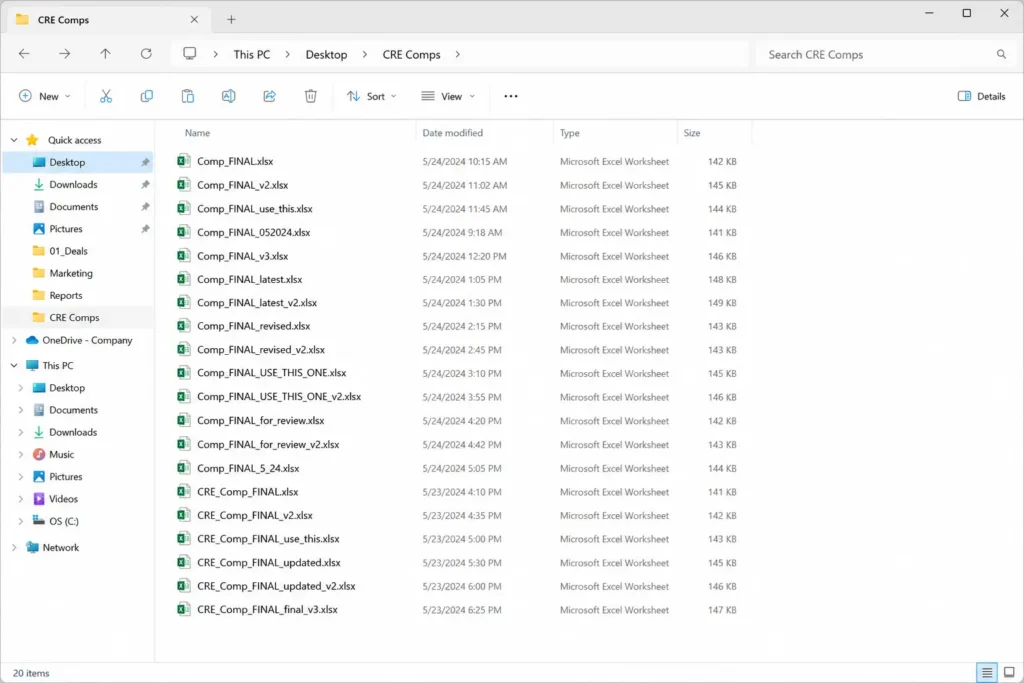
It is Friday afternoon. A partner asks for the latest comp file ahead of a Monday pitch. The shared drive shows three candidates: Comp_FINAL.xlsx, Comp_FINAL_v2.xlsx, and Comp_FINAL_use_this.xlsx. A fourth version sits in the senior partner’s personal folder under a name nobody else recognizes. Twenty minutes pass before anyone can say with confidence which file holds the current numbers. This is a comp management problem, and almost every brokerage that runs its comps in spreadsheets pays for it every single week.
Quick answer: Duplicate comp files cost brokerages in two ways. The visible cost is time: a ten-broker firm loses roughly 250 hours a year, about $18,750, to file hunts and reconciliation. The larger cost is invisible: comps entered into the wrong file or never entered at all, lost permanently. The fix is structural, not behavioral: one shared comp record the whole team edits in place, with version history handled by the system instead of the file name.
The problem nobody measures
Version conflict stays off the books because its cost is distributed across the team in small, unlogged increments. No one invoices twenty minutes of file hunting. No one reports the half hour spent copying rows from one spreadsheet into another to figure out which is current. Each incident is too small to escalate, so the total never appears on a P&L line, and a cost that never appears on a line item never gets fixed.
The pattern is not unique to real estate. The McKinsey Global Institute found that knowledge workers spend close to 20 percent of their workweek searching for and gathering internal information. Brokers are not exempt. A comp database that exists as four competing spreadsheets guarantees that a share of every week goes to search and reconciliation rather than deals.
In theory, the brokerage has one comp file. In practice, it has one file per person who ever needed to edit it under deadline. Every copy made to work offline, to protect an edit, or to email a snapshot becomes a new potential source of truth. The result is a recurring time cost the firm pays without ever measuring it.
The math is easy to run and hard to ignore. Assume each broker loses 30 minutes per week to file hunts and reconciliation, which most managing brokers who track it for a week find is conservative. For a ten-broker firm at a $75 fully loaded hourly rate, that is roughly 250 hours and about $18,750 a year. Cut the estimate in half and it still clears $9,000. But this figure counts search and reconciliation time only, and time is the least of it. The costs that actually hurt come from what these files lose.

The real cost: comps that disappear
Time loss is steady and recoverable. Data loss is silent and permanent. When comps live in competing spreadsheets, your firm loses proprietary data three ways, and you rarely see any of them happen.
Comps entered into the wrong file are lost forever
A broker enters a fresh closing into one version while the rest of the team has moved on to another. The comp is now stranded in an abandoned file that nobody will open again. It is not misfiled. It is gone, because no one will ever think to look there. Over a year, this quietly hollows out the firm’s institutional memory, one stranded comp at a time.
This is not a small-firm problem. Pixar nearly lost most of Toy Story 2 in 1998 when the film was accidentally deleted from its servers, and the backup system turned out to have been failing silently for weeks. The film survived only because one employee happened to keep a copy at home. Your comp database rarely gets that kind of luck. A comp typed into the wrong spreadsheet is backed up nowhere, and no one notices the gap until the day someone needs that number.

Comps never get entered at all
This is the larger and quieter loss. When capturing a comp means opening a file, deciding which version is current, and hunting for the right row, brokers do the mental math and decide it is not worth it. So the data point never enters any file. A number heard on a call, a figure in a forwarded email, a rent glimpsed on a competitor’s flyer: these are exactly the private, closed-deal comps your firm’s edge is built on, and they evaporate because the friction of capture is too high. The spreadsheet mess does not only lose the comps you have. It trains your team to stop capturing the ones they could have had.
Stale comps produce visible errors
The losses above are invisible. This one is not. A junior broker pulls from an outdated file, misses three recent closings, and builds a pricing opinion on stale comps that reaches a client before anyone catches it. Or two people present in the same meeting with numbers pulled from different versions, and the client spots the mismatch before the team does. There is also the file that lived on a departing broker’s laptop and left with them, which is a problem team permission controls exist to solve. Any one of these can cost more in fees or client confidence than the entire annual time estimate above.
Why naming conventions and shared-drive policies fail

Rules that depend on ten humans behaving consistently, every week, under deadline pressure will fail on schedule. A naming convention holds for about a month. Then a deadline hits, someone saves Comp_FINAL_v2_USE_THIS.xlsx, and the convention becomes one more version to reconcile.
Shared-drive version history does not solve it either. SharePoint and Google Drive track versions of a single file well, but they cannot stop people from making copies, and copying is the natural behavior when the file is the unit of storage. People duplicate files to work offline, to protect their edits, or to email a snapshot to a client. The policy fights the medium and the medium wins. For a fuller comparison of where spreadsheets hold up and where they break, see how Compstash compares with spreadsheets for team-based comp work.
The structural fix: comp management in one shared record
The durable fix replaces the file with a database record that every team member edits in place. There is nothing to copy, so there is nothing to fork. Version history becomes the system’s job rather than a suffix on a file name, and the current number is, by definition, the one in the record.
Any database-backed comp tool clears the version problem, and it is worth being direct about that. The evaluation criteria for a brokerage of three to fifty agents look like this:
- One shared record per comp, edited in place, with no export-and-reimport loop for routine work
- Permission controls, so juniors and assistants can enter data without the ability to overwrite or export the full database
- Change history handled automatically, so you can see who edited what and roll back a bad entry
- Bulk import, so the four spreadsheet versions you have today can be merged once and retired
Where Compstash fits
Compstash applies this structure to brokerage comps specifically. Comps live in one private database instead of a folder of spreadsheets, with permission controls for teams so a junior broker or VA can add records without touching what the partners rely on. Bulk upload merges your existing spreadsheet versions in one pass. One-click branded reports remove the main reason people export to Excel in the first place, which is where forks begin.
The difference from generic databases is that Compstash is broker-native and privacy-first. Because capture is fast and there is only one record, comps get entered instead of skipped, and none of them can be stranded in a dead file. Your comp data stays yours. It is never pooled, shared, or resold. To see it against your own spreadsheet mess, book a demo and run the same calculation against the subscription cost.
Frequently asked questions
Can comps be permanently lost in spreadsheets?
Yes. A comp entered into an abandoned file version is stranded where no one will look for it, and a comp never entered because capture felt too slow is lost before it is ever recorded. Both losses are silent, and neither shows up until someone needs the missing number.
What replaces spreadsheets for comp management?
A database-backed comp management platform replaces the file with a single shared record that the team edits in place. The system handles version history and permissions, so duplicate files cannot form and captured comps cannot be stranded. Compstash is one example built specifically for CRE brokerages.
Stop paying the tax
The time cost is easy to calculate and still understates the problem. The real damage is the comps your firm loses without noticing: the closing typed into a dead file, the number nobody bothered to capture, the data point that would have won the next pitch. You cannot recover a comp you never recorded. Moving comp management from a folder of competing files into one shared record stops the leak at the source, and the fix costs far less than what the leak quietly takes.
Start your free Compstash trial and give your team one comp record they can all trust, with permission controls that keep juniors safely inside the lines.
You may also like

Conquer Your Comps: How People Have Always Valued Property
Written by
Brian Christ

Managing CRE Comps in Spreadsheets: When Your File Starts to Break
Written by
Brian Christ

CRE Comp Management: Why Closed Deals Get Lost
Written by
Chippo Masayon