
Conquer Your Comps: How People Have Always Valued Property



My high school history teacher and high school English teacher rarely agreed on anything. But, the one thing they could agree on was the most important year in history – 1066. It was the year of the Norman conquest of England, which set the foundation for what would eventually become the British empire – check for my history teacher – and great English literature – check for my English teacher.
After William the Conqueror finished polishing off King Harold II at the Battle of Hastings, he had to assess the value of this new land he conquered. To do it, he commissioned the Domesday Book, a full survey of the land of England and Wales. He sent surveyors all over Britain to measure the land, count inhabitants, and, most importantly, assess the taxable value of every parcel of property.
Nearly 1,000 years later, we are still working to properly assess the value of our real estate. And, just like William the Conqueror, we often rely on professionals with local-market expertise to do the job.
What are Commercial Property Comps?

Commercial property comps, short for comparables, are records of recently leased or sold properties used to estimate the value of a similar property. Brokers use comps to advise clients on listing prices, lease rates, and offer terms. Without comps, every valuation becomes guesswork.
What data does a commercial property comp include?
A useful commercial property comp captures enough detail for a broker to apply it confidently to a new pitch. At minimum, it should include:
- Property address and location
- Asset class (office, retail, industrial, multifamily, or mixed-use)
- Building size and lot size
- Sale price or lease rate
- Transaction date
- Buyer and seller, or landlord and tenant
- Deal terms such as cap rate, lease length, escalations, or tenant improvement allowances
The more complete the record, the more useful the comp.
Sales comps vs lease comps
Comps fall into two main categories:
- Sales comps document closed property transactions. They inform valuation for owners considering a sale or refinance.
- Lease comps document executed leases. They inform pricing for landlords setting asking rents or tenants negotiating renewals.
Most brokers track both, since clients often need to understand sale value and rental income together.
Why the best comps are private
The challenge with comps is that the most valuable ones are private. Public listings show asking prices, not closing prices. Tax records lag behind the market and often miss the real terms. The comps that actually move deals forward, the ones with full financials, true effective rents, and the story behind why a deal closed where it did, live inside individual brokers’ files.
Assessing the Value of a Modern Commercial Property

There are a variety of tools available to assess the value of a piece of commercial property:
Publicly Available Sources:
Government and tax records can be used to see both the most recent sale of a property and the currently assessed value. For a residential property that traded recently, this may be all you need; however, for a commercial property that is sub-divided into multiple units or has a tax assessment out of line with its true value, they may not be a good indicator of fair market rent or property value.
Public Property Listings:
Another good way to assess the value of a commercial property is to look at available listings and see what is trading nearby. Using aggregator sites like Loopnet or Crexi or sites for local brokers can provide a good view of what’s listed in the market. These listings are typically free, but they only show you what’s available and a listing price, which may or may not be reflective of value. These sites won’t show you closed deals or the actual financials of closed transactions.
Market Research Tools
Market research tools like Costar or Moody’s CRE provide detailed market studies with estimated values and rents for many properties in the market, based on their research and the data provided to them by their customers and through the listing products they own and operate. These tools provide great insight into a market, but they can be very expensive and they often lack coverage on smaller cities and less dense submarkets.
Local Brokers
The absolute best way to assess the value of a property is by working with a local broker who has experience in the market. These brokers know the ins and outs of their markets and the history of the area’s submarkets and properties. They have their finger on the pulse of a market, knowing trends and expected shifts in the market for each asset class.
Evolving Tools for Local Brokers
The original Domesday Book was finally finished in 1086, where the single existing copy was kept in the royal treasury. The first printed copy – at this point for historians to study – was finally widely published in 1783. And, finally, in 2011, the entire Domesday Book was made available online with the Open Domesday project. It’s a wonderful resource if you own property in the UK and want to know what it was worth in 1086.
Today’s brokers are also making the shift to modern tools for tracking comps. Brokers manage their comps in a variety of ways:
Spiral Notebook and a Great Memory
Many brokers with long experience in a market have anecdotes and stories about every property in a market and have a great memory for previous deals and previous tenants. Having coffee with a broker who has done a lot of deals in the market will give you a very good sense of the market.
Excel or Smartsheet
In our survey of brokers, most of them keep their history of comps in an Excel spreadsheet. It’s cheap, easy, and can be managed over time. However, it can easily be corrupted, doesn’t allow for easy mapping or analytical analysis, and requires a graphic artist on the team to turn into meaningful presentations.
Smartsheet is an online database, with all of the flexibility of Excel, and also all of its downsides! Transitioning from Excel to Smartsheet allows for broader access, but it does not solve the data corruption issues or resolve the need for a graphic artist to build presentations
Compstash
Compstash is a next generation tool to manage comps. It allows users to transform their Excel spreadsheet or Smartsheet into a robust comp database. Compstash allows users to visualize their comps on a map, sort and filter to find the best comparable properties, share presentation-ready reports with their clients at the click of a button, and quickly assess a value’s property without worrying about data corruption.
What Are the Best Ways to Track Commercial Property Comps?
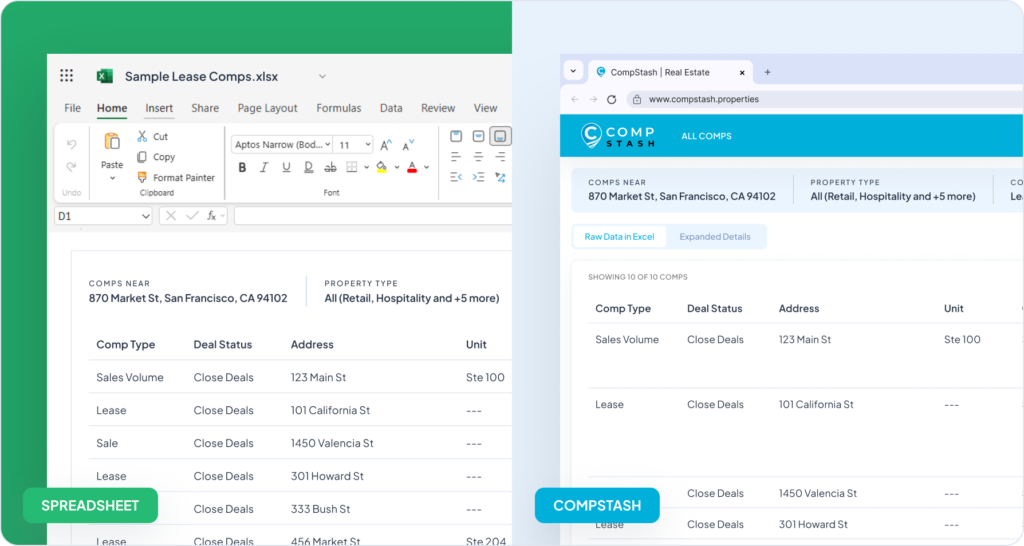
Brokers track their commercial property comps in three main ways, each with different tradeoffs for speed, accuracy, and data control.
Memory and personal notes
Veteran brokers often carry years of deal history in their heads, backed up by notebooks or scattered emails. This works for the broker who built the memory, but it does not scale to a team, a junior associate, or a virtual assistant who needs to pull a comp set on short notice.
Spreadsheets (Excel, Smartsheet, Google Sheets)
Most brokers keep their comps in a spreadsheet. It is cheap, familiar, and flexible. The downsides show up quickly: files get corrupted, version control breaks across team members, there is no map view or filtering by deal type, and turning a spreadsheet into a client-ready report requires manual formatting every time. Cloud options like Smartsheet and Google Sheets fix the sharing problem but inherit the rest.
Private comp management software
A newer category of tools, including Compstash, is built specifically for brokers who want to manage their own closed deal history without sharing it with the market. These platforms combine the flexibility of a spreadsheet with map views, branded one-click reports, and role-based access controls that decide exactly who sees which comps. The defining feature of this category is data privacy: comps stay with the broker and are never sold, aggregated, or resold.
Because a broker’s comps are how they provide value, Compstash allows users to control who can access their comps with tight security controls. Comps are never sold, aggregated, or shared. Only the individuals that brokers select can see comps, and they can only see the comps that the broker selects for them.
Don’t be a Bastard

Prior to his conquest of England, William the Conqueror was known as William the Bastard. His greatest achievement was uniting England and laying the foundation for the modern monarchy, but perhaps equally important was the Domesday Book, assessing the value of all he had captured. As you try to assess the value of your commercial real estate – be a Conqueror, don’t be a Bastard.
See how Compstash helps brokers conquer their comps with a private, secure, presentation-ready comp database built for the way you actually work. Request a demo today and take control of the comps you have earned.
You may also like

Managing CRE Comps in Spreadsheets: When Your File Starts to Break
Written by
Brian Christ

CRE Comp Management: Why Closed Deals Get Lost
Written by
Chippo Masayon

The CRE Comp Data Audit: A 5-Step Check on Where Your Closed Deals Actually Live
Written by
Chippo Masayon